

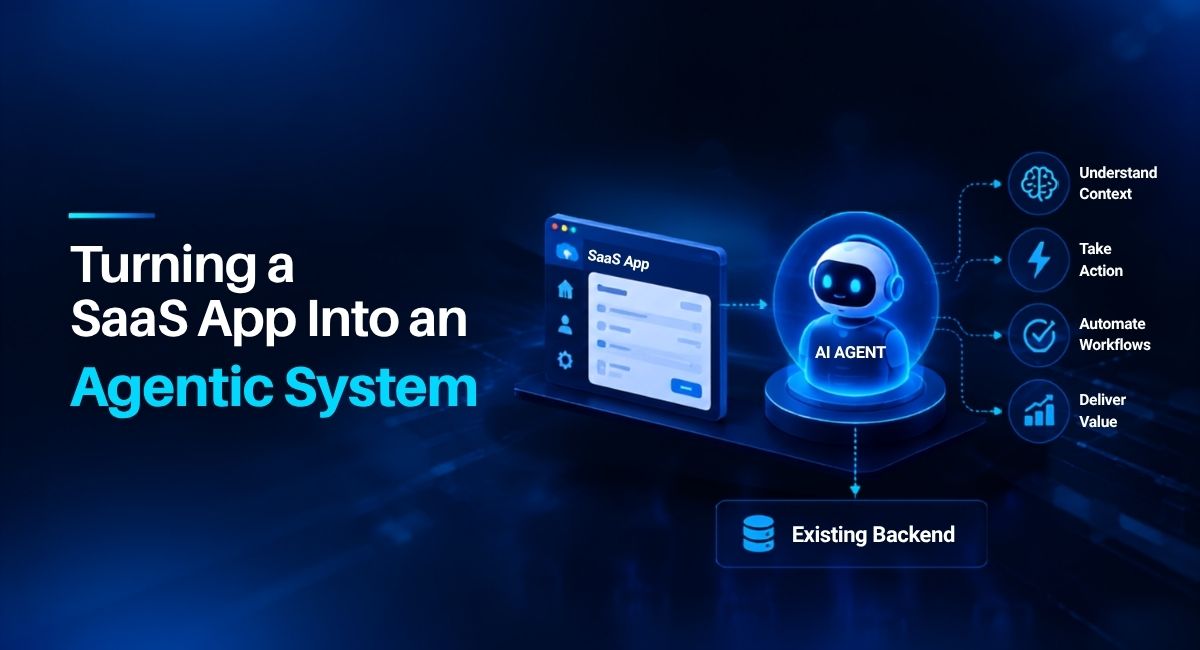
SaaS applications are entering a new era.
For years, SaaS products have relied on dashboards, forms, menus, buttons, and predefined workflows. Users navigate through different screens, enter information, and manually trigger actions to complete their tasks.
Now, agentic AI is changing how users interact with software.
Instead of simply responding to individual commands, AI agents can understand goals, reason through multi-step tasks, interact with software tools, retrieve information, make decisions, and execute authorized actions.
This transformation is creating a new opportunity for SaaS companies: Agentic SaaS Modernization.
But modernization does not necessarily mean rebuilding an entire application.
Businesses can add an intelligent agent layer on top of their existing SaaS infrastructure through APIs, tool integration, orchestration, permissions, and automation.
The result is an AI-enabled SaaS platform that can deliver intelligent, goal-oriented experiences while preserving the backend systems that already work.
What Is Agentic SaaS Modernization?
Agentic SaaS Modernization is the process of evolving an existing SaaS application by introducing AI agents that can understand user goals and autonomously perform tasks using the application's existing capabilities.
Traditional SaaS follows a relatively linear model:
User → Interface → Backend → Database → Result
An agentic SaaS architecture introduces an intelligent layer:
User → AI Agent → Tools/APIs → Existing Backend → Database
The AI agent acts as an intelligent orchestrator. It determines which actions are required and uses approved APIs or tools to execute them.
The existing backend remains responsible for core business logic, data management, authentication, and transactions.
This makes agentic modernization different from a complete application rewrite.
Why SaaS Companies Should Consider Agentic Modernization
Many SaaS businesses already have mature technology stacks.
Their applications may contain:
Established databases
REST or GraphQL APIs
Authentication systems
Payment integrations
Business rules
User management
Reporting systems
Third-party integrations
Automated workflows
Replacing these systems simply to introduce AI can be expensive and risky.
A better approach is often to modernize around the existing architecture.
With Agentic SaaS Modernization, companies can preserve their core systems while introducing AI capabilities where they provide the greatest value.
This allows businesses to modernize incrementally instead of undertaking a complete backend migration.
AI Agent Integration: The Bridge Between SaaS and AI
One of the most important components of agentic modernization is AI agent integration.
AI agents need controlled access to the functionality of the SaaS platform.
For example, a CRM may already have APIs for:
Creating leads
Updating customer records
Assigning sales representatives
Scheduling activities
Generating reports
Sending notifications
Instead of rebuilding these capabilities, businesses can make them available as AI tools.
For example:
AI Agent
   ↓
Tool Layer
   ↓
Existing API
   ↓
Business Logic
   ↓
Database
The agent decides what needs to be done, while the existing backend determines how the operation is actually performed.
This separation makes AI agent integration safer, more scalable, and easier to manage.
How an Existing SaaS App Can Become Agentic
Consider a project-management SaaS platform.
A traditional user might need to:
Create a project.
Add team members.
Create tasks.
Assign tasks.
Set deadlines.
Monitor progress.
An agentic system could allow the user to simply say:
"Create a project for our new mobile application, assign the development team, create the initial development tasks, and set deadlines based on the project timeline."
The AI agent can then:
Understand the objective.
Identify the required tools.
Retrieve available team members.
Create the project.
Generate tasks.
Assign responsibilities.
Set deadlines.
Return a summary to the user.
The backend does not have to be rewritten.
The agent uses the existing application capabilities through controlled interfaces.
The Architecture Behind Agentic SaaS Modernization
A practical Agentic SaaS Modernization architecture can contain several layers.
1. Existing SaaS Backend
The existing backend remains the foundation of the system.
It continues managing:
Business logic
Data
Authentication
Transactions
APIs
Existing workflows
This protects the investment already made in the application.
2. API and Tool Layer
The next step is to expose selected backend capabilities as structured tools.
For example:
get_customer()
create_customer()
update_customer()
create_invoice()
generate_report()
create_ticket()
assign_ticket()
Each tool should have clearly defined inputs, outputs, permissions, and validation rules.
3. AI Agent Layer
The AI agent interprets the user's goal and determines which tools are required.
It can manage:
Planning
Reasoning
Tool selection
Multi-step workflows
Context
Error handling
Decision-making
4. Model Layer
Large language models provide natural-language understanding and reasoning capabilities.
Depending on the use case, different models can support:
Reasoning
Classification
Summarization
Data extraction
Content generation
Decision support
5. User Experience Layer
Businesses can introduce an AI interface without removing the existing SaaS interface.
The product can provide:
Dashboard + AI Assistant + Agentic Workflows
This gives users the flexibility to continue using traditional workflows while gradually adopting AI-driven interactions.
APIs Are Critical for AI Agent Integration
APIs are one of the most important building blocks for AI agent integration.
A well-designed API allows agents to interact with application functionality without requiring direct database access.
For example:
User
 ↓
AI Agent
 ↓
Tool / API
 ↓
Business Logic
 ↓
Database
This architecture creates an important security boundary.
Instead of allowing an AI agent unrestricted access to application data, the system exposes only specific operations that the agent is authorized to perform.
For example, an agent might be allowed to:
Read customer information
Create support tickets
Generate reports
But not:
Delete customer accounts
Modify billing information
Change administrator permissions
This controlled approach makes AI agent integration significantly more reliable.
From SaaS Chatbots to Agentic SaaS
Adding a chatbot to an application does not automatically make it agentic.
There is an important difference.
Traditional AI Assistant
A user asks:
"How many unresolved support tickets do we have?"
The AI retrieves the information and responds.
Agentic SaaS
The user asks:
"Find all critical unresolved tickets, identify the appropriate support specialists, assign the tickets, and notify the team."
The agent can potentially:
Retrieve tickets
Analyze priority
Identify specialists
Check permissions
Assign tickets
Send notifications
Record the actions
The difference is execution.
Traditional AI primarily provides information.
Agentic AI can use tools to complete authorized objectives.
MCP and the Future of AI Agent Integration
The Model Context Protocol (MCP) is another technology that can support AI agent integration.
MCP provides a standardized approach for connecting AI systems with tools, resources, and external applications.
For SaaS companies, this can help expose application capabilities to AI systems in a structured way.
For example, a SaaS platform could provide tools such as:
Search Customers
Create Customer
Get Subscription
Update Subscription
Generate Report
Create Support Ticket
An AI agent can then discover and use these capabilities based on the task it needs to complete.
This creates an important opportunity for SaaS businesses to make their existing products agent-ready without rebuilding the entire backend.
Identify the Right Workflows for Agentic Modernization
Not every SaaS feature needs to become autonomous.
The best starting point is usually a workflow that is:
Repetitive
Time-consuming
Multi-step
Rules-based
Frequently performed
Valuable to the business
For example:
CRM SaaS
Lead qualification
Follow-up creation
Customer research
Sales task management
CRM updates
ERP SaaS
Invoice processing
Purchase workflows
Inventory monitoring
Financial reporting
Customer Support SaaS
Ticket classification
Priority detection
Ticket routing
Response generation
Escalation
HR SaaS
Candidate screening
Interview scheduling
Employee onboarding
Document generation
Project Management SaaS
Task creation
Assignment
Progress tracking
Deadline monitoring
Status reporting
The goal should not be to add AI everywhere.
The goal should be to identify where AI agents can deliver measurable business value.
Human-in-the-Loop Is Essential
Agentic systems should not automatically perform every action.
Businesses should classify actions based on their risk.
For example:
Low Risk
Create a reminder.
→ Agent can execute automatically.
Medium Risk
Send an email to a customer.
→ User approval may be appropriate.
High Risk
Issue a refund or change financial information.
→ Human approval should generally be required.
A mature Agentic SaaS Modernization strategy therefore includes:
AI Decision
     ↓
Risk Assessment
     ↓
Low Risk → Execute
     ↓
High Risk → Human Approval
     ↓
Execute + Audit
This approach provides a balance between automation and business control.
Security Must Be Part of AI Agent Integration
Giving AI agents access to SaaS functionality introduces new security requirements.
Agents should operate within the same permission framework as human users.
A secure architecture can follow:
AI Agent
   ↓
User Identity
   ↓
Permission Check
   ↓
Tool Authorization
   ↓
Backend API
   ↓
Business Logic
Important security controls include:
Role-based access control
Authentication
Authorization
API security
Input validation
Rate limiting
Audit logging
Sensitive-data protection
Human approval
Agent monitoring
The principle is simple:
An AI agent should never have more authority than the user or system role it represents.
Don't Build a Second Backend for AI
One of the biggest mistakes in SaaS AI modernization is creating a completely separate backend for the AI functionality.
Instead, businesses should think of AI as an intelligence and orchestration layer.
The existing backend remains responsible for:
Data + Business Rules + Transactions
The agentic layer handles:
Reasoning + Planning + Tool Selection + Workflow Orchestration
This separation reduces unnecessary duplication and makes future development easier.
It also means companies can upgrade their AI capabilities without repeatedly modifying the core SaaS architecture.
A Step-by-Step Agentic SaaS Modernization Strategy
Businesses can approach modernization incrementally.
Step 1: Audit the Existing SaaS Architecture
Identify:
APIs
Backend services
Databases
Business workflows
User roles
Existing integrations
Repetitive processes
Step 2: Find High-Value Agentic Workflows
Evaluate potential workflows based on:
Business value
Frequency
Automation potential
Complexity
Risk
Step 3: Build the Tool Layer
Convert selected backend capabilities into secure, structured tools.
Step 4: Implement AI Agent Integration
Connect the tools with an AI agent capable of understanding goals and orchestrating multi-step actions.
Step 5: Add Guardrails
Implement:
Authentication
Authorization
Validation
Approval workflows
Logging
Monitoring
Step 6: Launch a Focused Agent
Start with one high-value use case instead of attempting to make the entire application autonomous.
Step 7: Measure Performance
Monitor:
Tasks automated
Time saved
User adoption
Error rates
Workflow completion
Customer satisfaction
Operational cost reduction
Use these results to determine where additional agents can deliver value.
Benefits of Agentic SaaS Modernization
A carefully planned modernization strategy can provide several advantages.
Faster AI Adoption
Businesses can introduce intelligent capabilities without completely replacing their existing technology stack.
Lower Development Costs
Existing APIs and business logic can continue to be used.
Reduced Migration Risk
The core SaaS application remains operational throughout the modernization process.
Better User Experience
Users can interact with complex software using natural-language goals.
Increased Automation
AI agents can coordinate multiple actions across existing SaaS functionality.
Scalable AI Architecture
New agents and tools can be introduced progressively.
Competitive Advantage
A conventional SaaS product can evolve into an intelligent, agent-driven platform.
The Future of SaaS Is Agentic
The traditional SaaS experience has generally followed this pattern:
Click → Enter → Submit → Result
Agentic SaaS is moving toward:
Goal → Agent → Tools → Actions → Result
Users may no longer need to understand every feature or workflow inside an application.
Instead, they can describe what they want to accomplish, while an AI agent determines the steps required to achieve the objective.
This does not mean traditional SaaS interfaces will disappear.
Instead, the future is likely to be a combination of:
Traditional SaaS UI + AI Copilots + Autonomous Agents + Automated Workflows
That is where Agentic SaaS Modernization becomes strategically important.
Conclusion
Agentic SaaS Modernization provides SaaS companies with a practical path toward AI transformation without unnecessarily rebuilding their existing backend.
By leveraging existing APIs, creating secure AI tools, implementing AI agent integration, adding orchestration, and introducing appropriate security and human-approval mechanisms, businesses can transform existing SaaS products into intelligent, goal-oriented platforms.
The objective is not to rebuild everything.
It is to make existing software intelligent and agent-accessible.
For SaaS businesses, this approach can reduce development risk, accelerate AI adoption, improve automation, and create a more intelligent user experience.
At Techware Lab, we help businesses modernize SaaS applications with AI agents, intelligent automation, custom API integrations, and scalable agentic architectures. From MVP development to transforming existing applications, the focus is on building practical AI solutions without unnecessary redevelopment of proven technology.
Turn your existing SaaS into an AI-powered, agent-ready platform.
👉 Talk to our AI development team today and explore your Agentic SaaS modernization opportunity.