

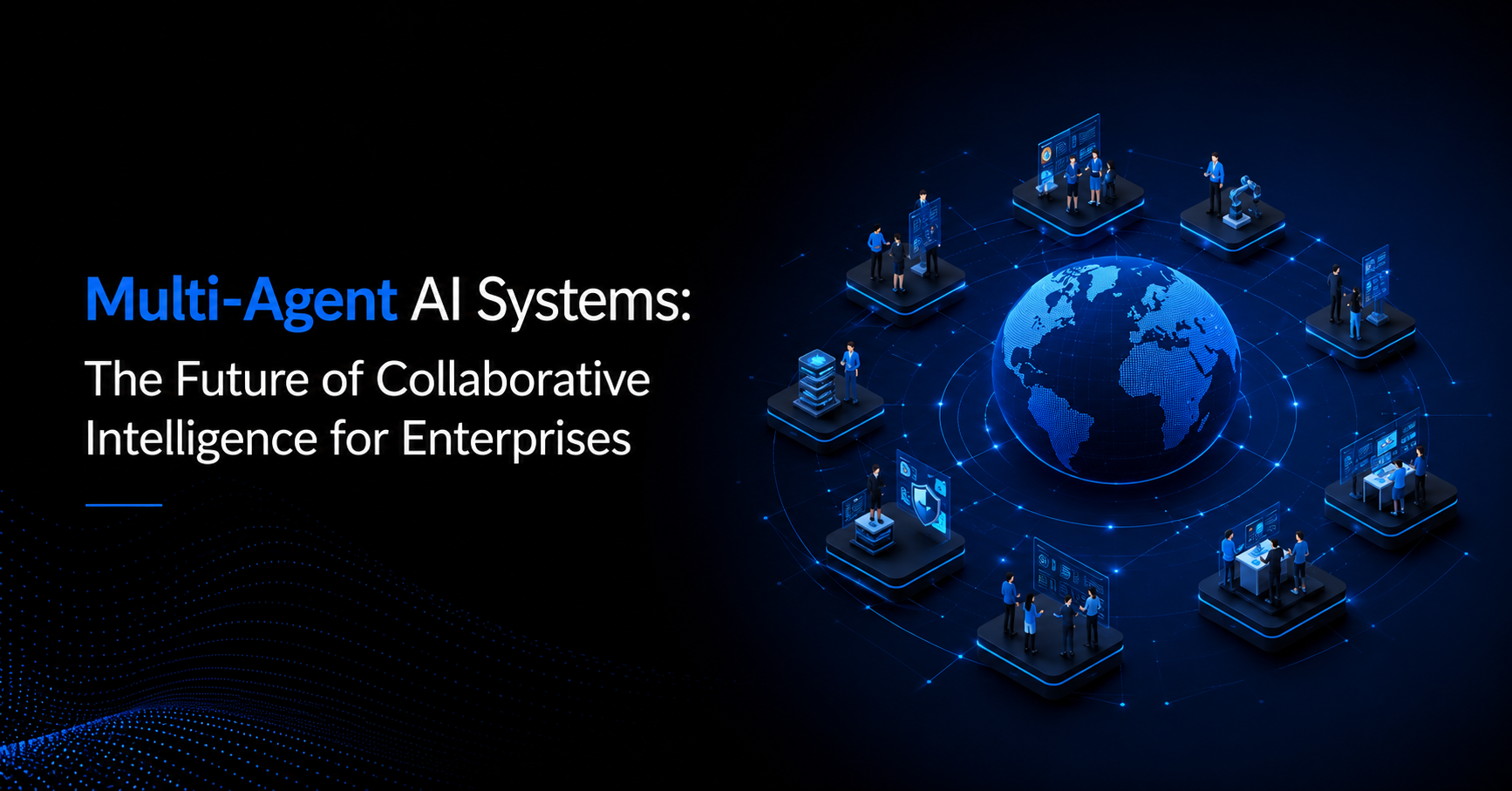
Artificial Intelligence is rapidly evolving beyond single-purpose chatbots and standalone AI tools. Today, organizations are exploring a new frontier in AI innovation: Multi-Agent AI Systems. As businesses seek more intelligent, scalable, and autonomous solutions, multiple AI agents working together are emerging as a powerful architectural pattern that is reshaping enterprise operations.
From automating complex workflows to enabling intelligent decision-making across departments, Multi-Agent AI Systems are becoming a key component of digital transformation strategies. Businesses that embrace this technology can unlock unprecedented levels of efficiency, collaboration, and innovation.
What Are Multi-Agent AI Systems?
A Multi-Agent AI System consists of multiple autonomous AI agents that collaborate to achieve specific goals. Unlike traditional AI models that operate independently, these agents communicate, coordinate, and share information to solve complex tasks more effectively.
Each AI agent is designed with specialized capabilities and responsibilities. For example, one agent may gather data, another may analyze information, a third may generate reports, and a fourth may interact with users. Together, they function as a coordinated team, similar to how employees collaborate within an organization.
This collaborative approach enables AI systems to handle sophisticated business processes that would be difficult or inefficient for a single AI model to manage alone.
How Multi-Agent Systems Work
A Multi-Agent System typically includes several specialized AI agents that work within a shared environment. These agents can:
Collect and process information from multiple sources
Communicate with other agents in real time
Coordinate actions based on shared objectives
Make independent decisions within defined parameters
Adapt to changing conditions and business requirements
For example, in a customer support environment, one AI agent may receive customer inquiries, another may access relevant product information, a third may evaluate customer sentiment, and a fourth may recommend appropriate solutions. Together, they create a seamless and intelligent customer experience.
Why Multi-Agent AI Systems Are Trending
The growing popularity of Multi-Agent AI Systems is driven by several factors:
Increased Business Complexity
Modern enterprises manage vast amounts of data, applications, and workflows. Single AI systems often struggle to handle the complexity of interconnected business processes. Multi-agent architectures provide a more flexible and scalable solution.
Advancements in Agentic AI
The rise of Agentic AI has enabled AI systems to perform tasks independently, make decisions, and execute workflows. Multi-agent environments take this capability further by allowing multiple intelligent agents to collaborate toward shared objectives.
Better Scalability
Organizations can easily add, modify, or remove individual agents without disrupting the entire system. This modular architecture makes Multi-Agent Systems highly adaptable to evolving business needs.
Enhanced Problem Solving
Complex business challenges often require expertise from multiple domains. Multi-Agent Systems distribute responsibilities among specialized agents, improving accuracy, efficiency, and decision quality.
Building Collaborative AI Workforces
One of the most exciting applications of Multi-Agent Systems is the creation of collaborative AI workforces.
Just as human teams consist of individuals with different skills and responsibilities, AI workforces can include specialized agents working together to achieve business goals.
Examples include:
Sales and Marketing Teams
Lead generation agents identify potential customers.
Research agents gather market intelligence.
Content creation agents develop marketing materials.
Campaign optimization agents analyze performance and suggest improvements.
Customer Support Teams
Inquiry management agents handle incoming requests.
Knowledge retrieval agents access support documentation.
Escalation agents identify complex cases requiring human intervention.
Feedback analysis agents monitor customer satisfaction.
Software Development Teams
Requirement analysis agents gather project specifications.
Coding agents generate initial code structures.
Testing agents identify bugs and vulnerabilities.
Deployment agents manage software releases.
By combining these capabilities, organizations can automate large portions of business operations while maintaining efficiency and quality.
Multi-Agent Architecture for Enterprises
Implementing a successful Multi-Agent System requires a robust architectural framework.
Specialized Agents
Each agent should have clearly defined roles and responsibilities. Specialization improves performance and reduces redundancy.
Communication Layer
Agents must communicate effectively using structured protocols. Technologies such as APIs, message queues, and Model Context Protocol (MCP) integrations can facilitate seamless information exchange.
Shared Knowledge Base
A centralized knowledge repository enables agents to access consistent and up-to-date information. This ensures accurate decision-making across the system.
Orchestration and Governance
An orchestration layer coordinates agent activities, manages workflows, and enforces business rules. Governance mechanisms ensure compliance, security, and accountability.
Human Oversight
While Multi-Agent Systems can automate many tasks, human supervision remains essential for strategic decision-making, quality assurance, and exception handling.
Real-World Enterprise Applications
Organizations across industries are already exploring Multi-Agent AI solutions.
Healthcare
AI agents collaborate to analyze patient records, recommend treatments, monitor health conditions, and support clinical decision-making.
Financial Services
Multi-Agent Systems assist with fraud detection, risk assessment, regulatory compliance, investment analysis, and customer service.
Manufacturing
AI agents monitor equipment performance, optimize production schedules, manage inventory, and predict maintenance requirements.
E-Commerce
Multiple agents work together to personalize shopping experiences, manage supply chains, optimize pricing, and improve customer engagement.
Human Resources
AI agents streamline recruitment, candidate screening, employee onboarding, workforce analytics, and performance management.
Benefits of Multi-Agent AI Systems
Organizations adopting Multi-Agent Systems can gain significant advantages:
Improved Efficiency
Parallel processing allows multiple agents to work simultaneously, reducing completion times for complex tasks.
Greater Flexibility
Businesses can customize and expand agent capabilities without redesigning entire systems.
Enhanced Decision-Making
Collaborative intelligence enables more informed and accurate business decisions.
Increased Resilience
If one agent encounters issues, other agents can continue operating, improving system reliability.
Reduced Operational Costs
Automation of repetitive tasks helps organizations reduce manual workloads and optimize resource allocation.
Challenges and Considerations
Despite their benefits, Multi-Agent Systems also present challenges.
Coordination Complexity
Managing communication and collaboration between multiple agents requires sophisticated orchestration mechanisms.
Data Security
Organizations must implement strong security controls to protect sensitive information shared among agents.
Governance and Compliance
As AI systems become more autonomous, businesses must ensure compliance with industry regulations and ethical AI standards.
Performance Monitoring
Continuous monitoring is necessary to evaluate agent performance, identify bottlenecks, and maintain operational efficiency.
Addressing these challenges is essential for successful enterprise adoption.
The Future of Distributed AI Agents
The future of AI is moving toward distributed intelligence, where networks of specialized agents collaborate across systems, platforms, and organizations.
Emerging technologies such as Agentic AI, Model Context Protocol (MCP), AI-native software architectures, and advanced orchestration frameworks are accelerating this transformation.
Future Multi-Agent Systems may:
Manage entire business workflows autonomously.
Collaborate across departments and organizational boundaries.
Integrate seamlessly with enterprise applications and databases.
Continuously learn and improve through shared experiences.
Operate as intelligent digital workforces alongside human employees.
As AI capabilities continue to evolve, Multi-Agent Systems are expected to become a foundational component of enterprise technology ecosystems.
Conclusion:
Multi-Agent AI Systems represent the next major evolution in artificial intelligence. By enabling multiple specialized AI agents to collaborate, communicate, and solve complex problems together, organizations can achieve greater efficiency, scalability, and innovation.
From customer service and software development to healthcare and finance, Multi-Agent architectures are transforming how businesses operate and compete in the digital age. Companies that invest in collaborative AI workforces today will be better positioned to leverage the full potential of distributed intelligence in the future.
At Techware Lab, we help businesses explore and implement advanced AI solutions, including Multi-Agent Systems, Agentic AI applications, AI-native software development, and enterprise automation strategies. As the future of work becomes increasingly intelligent and interconnected, Multi-Agent AI Systems will play a critical role in driving sustainable business growth and digital transformation.
Contact our AI experts today! to discover how Multi-Agent Systems can revolutionize your business and create a future-ready enterprise.