

Modern websites are no longer limited to static HTML pages. Businesses increasingly rely on dynamic web applications that deliver personalized content, interactive experiences, real-time data, and advanced functionality. Behind these experiences is an important technical process known as web rendering.
When developing a modern website or web application, one of the key architectural decisions is whether to use Server-Side Rendering (SSR), Client-Side Rendering (CSR), or a combination of both.
In 2026, the question is no longer simply whether SSR or CSR is better. The right approach depends on the website's goals, content, user experience, SEO requirements, application complexity, and performance expectations.
What Is Rendering in Web Development?
Rendering is the process of transforming website resources such as HTML, CSS, JavaScript, and data into the visual webpage that users see and interact with in a browser. The browser receives these resources and processes them to create the final interface displayed on the screen.
For example, when a visitor opens a product page, the website needs to retrieve the required information, construct the page, apply styling, execute JavaScript where necessary, and display the finished interface.
The main difference between SSR and CSR is where and when the initial HTML is generated.
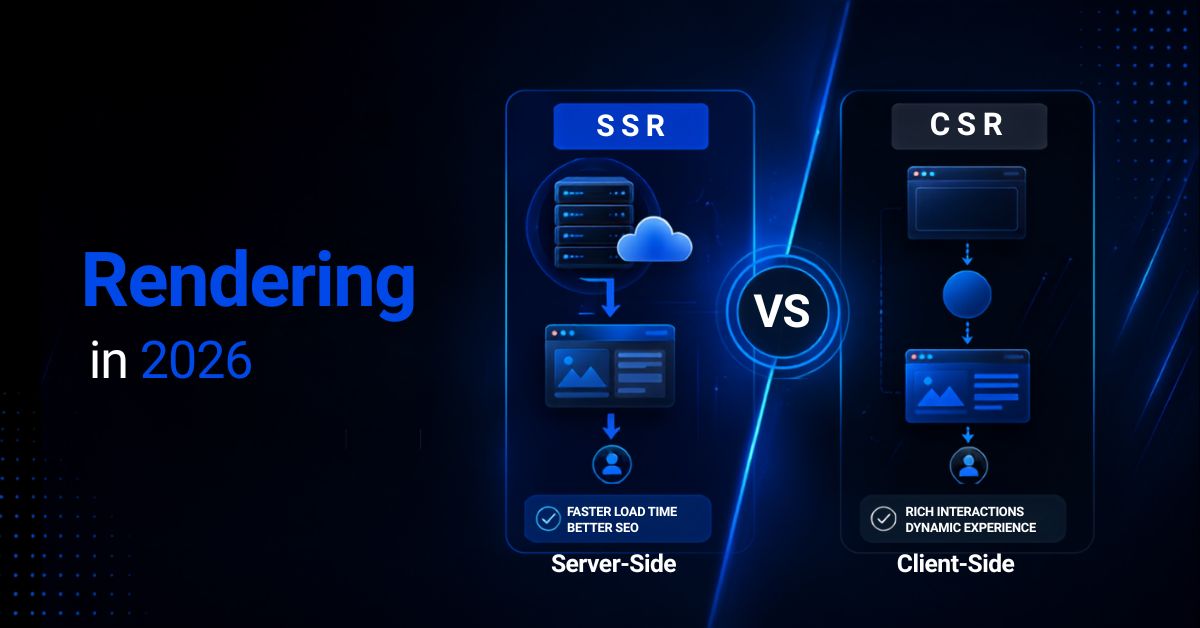
With SSR, the server generates the HTML before sending it to the browser. With CSR, the browser uses JavaScript to generate the page content after receiving the application's resources.
Understanding this difference is important because rendering architecture can influence website performance, SEO, scalability, accessibility, and user experience.
What Is Server-Side Rendering (SSR)?
Server-Side Rendering (SSR) is a web development approach where the server generates the HTML for a requested page and sends the rendered result to the browser.
Instead of requiring the browser to build the initial page entirely through JavaScript, the server prepares the page content and returns HTML that is substantially ready for the browser to display.
A simplified SSR process looks like this:
User Request → Server → Data/API → HTML Generation → Browser → Interactive Page
For example, imagine a user searches for a product on an e-commerce website. The server can retrieve the product information, generate the relevant HTML, and send that content to the browser.
The browser can then display the initial content while JavaScript loads the interactive functionality.
Benefits of SSR
1. Faster Initial Content Delivery
Because the server can generate the initial HTML, users may receive meaningful page content without waiting for the browser to construct everything through JavaScript.
2. SEO-Friendly Architecture
SSR can make important page content available directly in the initial HTML. Google can process JavaScript, but Google also notes that server-side or pre-rendering can improve website speed for users and crawlers, and not all crawlers can execute JavaScript.
3. Better Performance for Content-Heavy Websites
SSR can be particularly useful for websites where users need to see meaningful content quickly, such as news websites, publishing platforms, service websites, e-commerce stores, and content-driven business websites.
4. Better Social Sharing Compatibility
Server-rendered HTML can make it easier for crawlers and social platforms to access important page content and metadata.
5. Reduced Client-Side Processing
Some processing and data-fetching responsibilities can be moved to the server, reducing the amount of work that must initially be performed by the user's device.
What Is Client-Side Rendering (CSR)?
Client-Side Rendering (CSR) is an approach where the browser uses JavaScript to generate and update the webpage interface.
In a typical CSR application, the server initially sends the required HTML structure and JavaScript assets. The browser then executes JavaScript, retrieves necessary data, and builds the user interface.
A simplified CSR process looks like this:
User Request → Server → HTML + JavaScript → Browser → JavaScript Execution → Data → Rendered Interface
CSR is widely used for highly interactive web applications where much of the user experience happens inside the browser.
Benefits of CSR
1. Highly Interactive Experiences
CSR is well suited to applications where users frequently interact with the interface without requiring complete page reloads.
Examples include:
Online dashboards
Project management platforms
SaaS applications
Business management systems
Web-based editors
Customer portals
2. Smooth Navigation
Once the application has loaded, users can often navigate between views without requesting an entirely new document from the server.
3. Reduced Server Rendering Work
The server can focus on delivering application resources and data while the browser handles much of the interface rendering.
4. Excellent for Application-Like Experiences
CSR works particularly well when the website behaves more like software than a traditional content-focused website.
SSR vs. CSR for SEO in 2026
SEO is one of the most important factors businesses should consider when selecting a rendering strategy.
Google Search can execute JavaScript and processes JavaScript-powered websites through crawling, rendering, and indexing stages. However, Google also recommends approaches such as server-side rendering, static rendering, or hydration when appropriate.
This means a CSR website can be indexed, but implementation quality matters.
Potential problems can occur when:
Important content depends entirely on JavaScript.
Content is loaded too late.
Internal links are generated incorrectly.
Metadata is not properly rendered.
JavaScript errors prevent content from appearing.
Search engines or other crawlers cannot access required resources.
Important content is missing from the rendered HTML.
For SEO-focused websites, SSR or static/pre-rendered approaches can simplify content discoverability and improve the initial delivery of important information.
However, rendering alone does not guarantee rankings. Technical SEO, content quality, internal linking, structured data, performance, accessibility, crawlability, and overall website quality remain important.
Which Is Faster: SSR or CSR?
There is no universal answer.
SSR can provide users with meaningful HTML earlier because the server prepares the initial page. However, server-side rendering can increase server processing requirements, particularly for highly dynamic websites.
CSR can reduce the amount of server-side rendering work, but the browser may need to download and execute JavaScript before the complete interface becomes available.
The actual performance depends on factors such as:
Server response time
JavaScript bundle size
API performance
Database queries
Caching
CDN configuration
Image optimization
Code splitting
Browser capabilities
Network conditions
Rendering architecture
This is why professional development teams should measure real-world performance rather than choosing a technology simply because it is popular.
SSR and CSR Are Not Mutually Exclusive
One of the biggest developments in modern web development is the ability to combine server and client rendering.
A website does not necessarily need to be entirely SSR or entirely CSR.
For example, a business website could use server rendering for:
Homepage content
Service pages
Blog articles
Product pages
Location pages
And client-side rendering for:
Search filters
Interactive calculators
Account dashboards
Forms
Live notifications
Interactive components
This hybrid approach can provide a strong balance between SEO, performance, scalability, and interactivity.
Modern frameworks such as Next.js support server and client environments and allow developers to determine where different parts of an application should execute. Next.js uses Server Components by default in its App Router architecture, while Client Components can be introduced when browser-side interactivity is required.
SSR, CSR, and the Modern Web Development Landscape in 2026
Web development in 2026 is increasingly moving toward hybrid rendering architectures rather than rigidly choosing one rendering model.
Modern applications may combine:
Server-side rendering
Static generation
Client-side rendering
Server Components
Client Components
API-driven architectures
Edge delivery
CDN caching
Streaming
Progressive enhancement
The goal is to place the right workload in the right environment.
For example, a content-heavy page can be rendered on the server while a highly interactive component can execute in the browser.
This allows developers to optimize individual parts of an application rather than forcing the entire website into one rendering model.
How Should Businesses Choose Between SSR and CSR?
The correct architecture depends on the purpose of the website.
Choose SSR When:
Organic search traffic is important.
Pages contain public content.
Fast initial content delivery is a priority.
You operate an e-commerce website.
You have a content-heavy website.
You need strong crawlability.
Users frequently arrive through search engines.
Choose CSR When:
The website behaves primarily like an application.
Users spend significant time interacting with dashboards.
Real-time interface updates are important.
SEO is not the primary acquisition channel.
Most content is private or authenticated.
Rich browser-side interactions are central to the product.
Choose a Hybrid Approach When:
You need both SEO and advanced interactivity.
Some pages are public while others are authenticated.
Different components have different performance requirements.
Your website contains both marketing pages and application functionality.
For many modern business platforms, a hybrid architecture can provide the most flexibility.
Why a Professional Web Development Company Matters
Choosing between SSR and CSR is not simply a matter of selecting a framework.
A professional web development company should first understand the business objectives and then design the appropriate technical architecture.
An experienced development team can evaluate:
Business Requirements
What does the website need to accomplish? A corporate website, SaaS platform, marketplace, e-commerce store, and internal business application can have completely different technical requirements.
SEO Requirements
If organic search is a major source of leads, developers need to consider rendering, metadata, crawlability, canonical URLs, structured data, internal linking, and JavaScript behavior during development.
Performance Requirements
Developers need to identify bottlenecks across the server, database, APIs, JavaScript, images, third-party scripts, and browser rendering.
Scalability
A website that works for 1,000 users may require a different architecture when it needs to support hundreds of thousands of users.
Security
Rendering architecture also needs to be implemented alongside appropriate authentication, authorization, input validation, API security, data protection, and infrastructure controls.
Long-Term Maintainability
Professional development is not only about launching a website. The architecture should also be maintainable, testable, scalable, and adaptable as the business grows.
A professional web development company can evaluate these factors before deciding whether SSR, CSR, static generation, or a hybrid architecture is the right solution.
Conclusion:
Server-Side Rendering and Client-Side Rendering are not competing technologies where one will completely replace the other.
In 2026, successful web development is increasingly about choosing the right rendering strategy for each type of page and component.
SSR can be highly valuable for SEO, fast initial content delivery, and content-driven websites. CSR can provide powerful interactivity and application-like experiences. Hybrid approaches can combine the strengths of both.
The most important decision is therefore not simply "SSR or CSR?" but rather:
"Which rendering architecture best supports the business, users, SEO strategy, performance requirements, and future growth of the application?"
Working with a professional web development company can help businesses answer that question with a clear technical strategy rather than making architecture decisions based only on trends.
The right architecture can create a website that is not only visually impressive, but also fast, searchable, scalable, secure, and ready for long-term growth.
Build a Faster, Smarter Web Experience
Not sure whether SSR, CSR, or a hybrid architecture is right for your website? Our professional web development team can help you choose the right technology and build a fast, scalable, SEO-friendly web solution tailored to your business goals.
Ready to build a high-performance website? Get in touch with our web development experts today.