

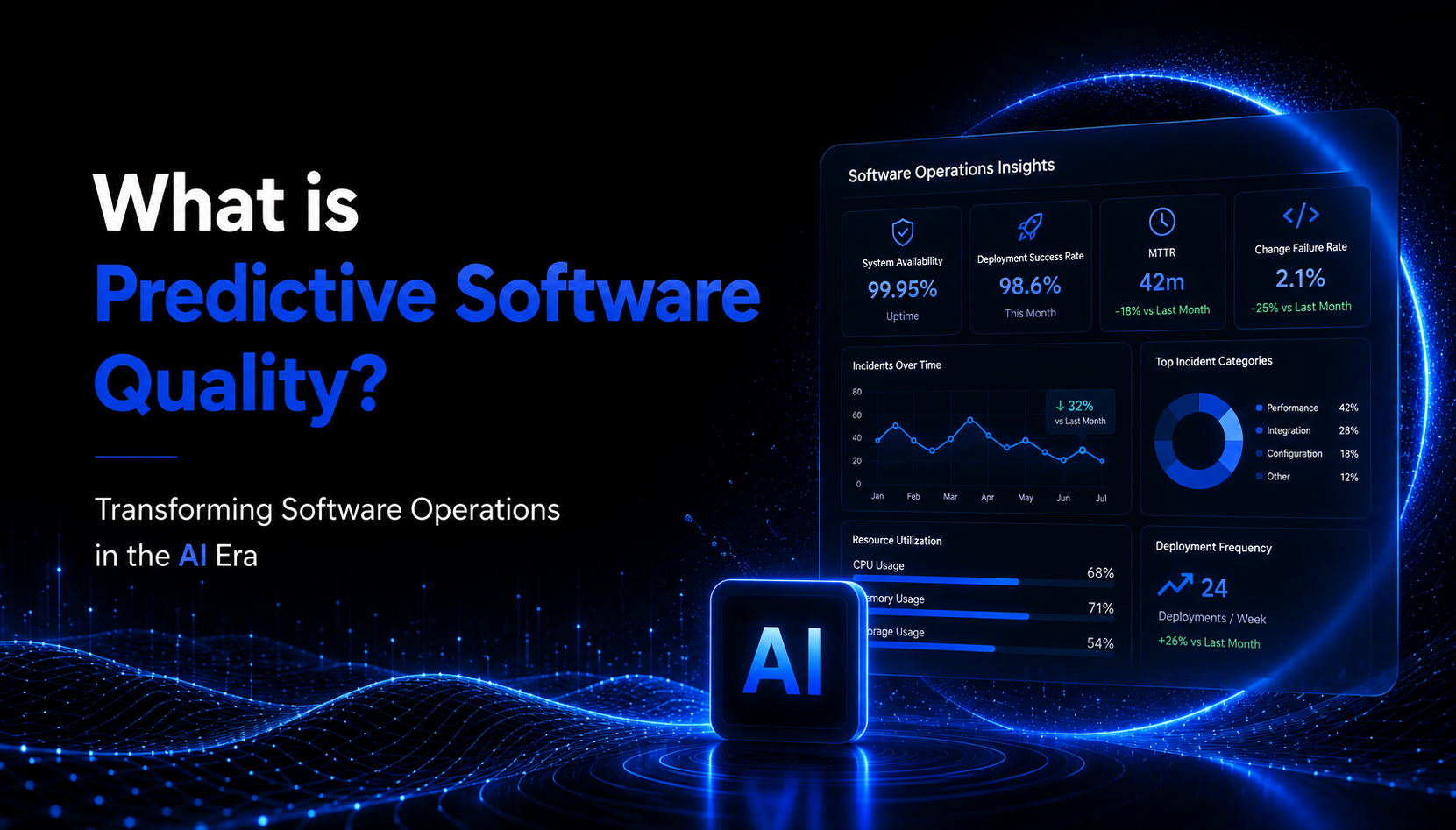
Software development has entered a new era where speed, reliability, and user experience determine business success. Traditional software quality assurance methods often identify issues after they occur, resulting in costly fixes, operational disruptions, and customer dissatisfaction. As artificial intelligence continues to reshape the technology landscape, organizations are adopting a more proactive approach known as Predictive Software Quality.
Predictive Software Quality leverages AI, machine learning, analytics, and real-time monitoring to forecast software issues before they impact users. Instead of reacting to bugs, performance bottlenecks, or security vulnerabilities, businesses can anticipate and prevent them. This shift is revolutionizing software operations and enabling organizations to build more resilient, intelligent, and scalable digital solutions.
At Techware Lab, we help businesses embrace AI-driven software development and operations practices that improve product quality, reduce downtime, and accelerate innovation.
Understanding Predictive Software Quality
Predictive Software Quality refers to the use of AI and data-driven insights to predict potential software defects, failures, performance issues, and operational risks before they occur.
By analysing historical development data, testing results, user behaviour patterns, system logs, infrastructure metrics, and deployment history, predictive models can identify areas that are most likely to experience problems.
Unlike traditional quality assurance processes that focus on detecting issues during testing or production, predictive quality management focuses on prevention.
Key Objectives of Predictive Software Quality
Reduce software defects before release
Predict application failures and outages
Improve software reliability and performance
Enhance customer experience
Optimize testing efforts
Accelerate development cycles
Minimize operational costs
Strengthen software security
The Evolution from Reactive to Predictive Operations
Traditional Software Operations
In conventional software environments:
Bugs are discovered during testing or after deployment
Teams react to incidents after users report them
Performance issues are identified through manual monitoring
Quality assurance relies heavily on human intervention
Root cause analysis consumes significant time and resources
This reactive model often leads to:
Increased downtime
Customer frustration
Revenue loss
Delayed releases
High maintenance costs
AI-Driven Predictive Operations
Modern AI-powered software operations shift the focus toward anticipation and prevention.
Organizations can now:
Predict software failures before they occur
Detect anomalies in real time
Forecast infrastructure capacity requirements
Identify vulnerable code segments
Automate quality assurance processes
Continuously optimize application performance
This proactive approach enables businesses to maintain high service availability while improving development efficiency.
How Predictive Software Quality Works
Predictive quality systems combine multiple technologies to generate actionable insights.
1. Data Collection
The system gathers data from various sources, including:
Source code repositories
CI/CD pipelines
Application logs
Performance monitoring tools
User interaction analytics
Security reports
Test execution results
The larger and more accurate the dataset, the better the prediction outcomes.
2. Machine Learning Analysis
Machine learning algorithms analyse patterns and correlations within the collected data.
They identify:
Frequently failing modules
High-risk code changes
Performance degradation trends
Potential security vulnerabilities
Infrastructure bottlenecks
3. Risk Prediction
AI models generate risk scores for applications, modules, and deployments.
Examples include:
Probability of deployment failure
Likelihood of production defects
Risk of application crashes
Expected performance degradation
4. Automated Recommendations
The system provides actionable recommendations such as:
Additional testing requirements
Code optimization opportunities
Infrastructure scaling suggestions
Security enhancements
Deployment risk mitigation strategies
Key Technologies Behind Predictive Software Quality
Artificial Intelligence
AI enables systems to analyse vast amounts of operational and development data faster than human teams.
Machine Learning
Machine learning models continuously improve prediction accuracy by learning from historical outcomes and real-world incidents.
AIOps (Artificial Intelligence for IT Operations)
AIOps platforms automate monitoring, event correlation, anomaly detection, and incident prediction.
DevOps Analytics
Modern DevOps tools generate valuable operational insights that fuel predictive quality systems.
Observability Platforms
Advanced observability solutions provide comprehensive visibility into:
Application performance
Infrastructure health
User experience
Network behaviour
These insights help predictive models identify potential issues early.
Benefits of Predictive Software Quality
Improved Software Reliability
Predictive models identify high-risk areas before deployment, reducing production defects and improving application stability.
Faster Release Cycles
Development teams spend less time fixing post-release issues and more time delivering new features.
Reduced Operational Costs
Preventing failures is significantly less expensive than resolving major production incidents.
Enhanced Customer Experience
Reliable software leads to:
Faster response times
Reduced downtime
Improved usability
Higher customer satisfaction
Better Resource Allocation
Teams can focus testing efforts on components with the highest risk scores instead of testing every module equally.
Increased Security
AI can predict security vulnerabilities based on coding patterns and historical attack data, helping organizations strengthen their defences proactively.
Predictive Quality in Modern DevOps and DevSecOps
Predictive Software Quality is becoming an essential component of modern DevOps and DevSecOps environments.
Continuous Quality Monitoring
AI continuously evaluates software health throughout the development lifecycle.
Intelligent Test Automation
Machine learning helps prioritize test cases that are most likely to uncover defects.
Predictive Security Analysis
Security teams can identify:
Vulnerable code segments
Misconfigurations
Potential attack vectors
before they become exploitable threats.
Deployment Risk Assessment
AI evaluates deployment readiness by analysing:
Code complexity
Change history
Infrastructure dependencies
Previous release outcomes
This reduces deployment failures and rollback incidents.
Real-World Applications Across Industries
FinTech
Financial institutions use predictive quality systems to ensure:
Transaction reliability
Fraud detection accuracy
Regulatory compliance
High platform availability
Healthcare
Healthcare applications leverage predictive monitoring to maintain uninterrupted access to critical patient data and services.
E-Commerce
Online retailers use predictive analytics to prevent performance issues during high-traffic events and seasonal sales.
Logistics
Logistics platforms predict system bottlenecks and optimize operational workflows for real-time delivery tracking.
Manufacturing
Manufacturers use predictive software operations to support smart factories and Industrial IoT ecosystems.
Challenges in Implementing Predictive Software Quality
While the benefits are substantial, organizations should address several challenges:
Data Quality
AI predictions are only as accurate as the data used to train the models.
Integration Complexity
Legacy systems may require modernization before predictive capabilities can be fully implemented.
Skill Gaps
Organizations need expertise in:
AI engineering
Machine learning
Data analytics
Cloud-native operations
Model Maintenance
Predictive models must be continuously updated to remain accurate as applications evolve.
The Future of Software Operations in the AI Era
As AI technologies mature, software operations will become increasingly autonomous.
Future software quality systems may include:
Self-healing applications
Autonomous incident resolution
AI-driven code reviews
Predictive cybersecurity frameworks
Intelligent infrastructure optimization
Fully automated quality assurance pipelines
Organizations that adopt predictive quality practices today will gain a significant competitive advantage through improved reliability, faster innovation, and lower operational risk.
How Techware Lab Helps Businesses Build AI-Driven Software Quality Systems
At Techware Lab, we specialize in developing intelligent software solutions that leverage AI, machine learning, cloud technologies, and modern DevOps practices.
Our expertise includes:
Predictive Analytics Solutions
DevOps and AIOps Implementation
Cloud-Native Application Development
Intelligent Monitoring Systems
Software Quality Engineering
Enterprise Digital Transformation
Custom AI Solutions
We help organizations transform traditional software operations into intelligent, predictive ecosystems that deliver exceptional performance, reliability, and scalability.
Conclusion:
Predictive Software Quality represents the next evolution of software engineering and operations. By combining AI, machine learning, analytics, and automation, organizations can move beyond reactive problem-solving and proactively prevent software failures before they occur.
In the AI era, software quality is no longer just about testing applications, it is about continuously predicting, monitoring, and optimizing performance throughout the entire software lifecycle. Businesses that embrace predictive software quality will be better positioned to deliver superior digital experiences, reduce operational risks, and accelerate innovation in an increasingly competitive marketplace.
As software systems become more complex, predictive quality management will transition from a competitive advantage to a business necessity, making AI-driven software operations a cornerstone of future digital success.
Partner with Techware Lab to build smarter, more reliable, and future-ready software.
Get Started Today! Talk to our AI and software development specialists and take the first step toward predictive software quality and operational excellence.