

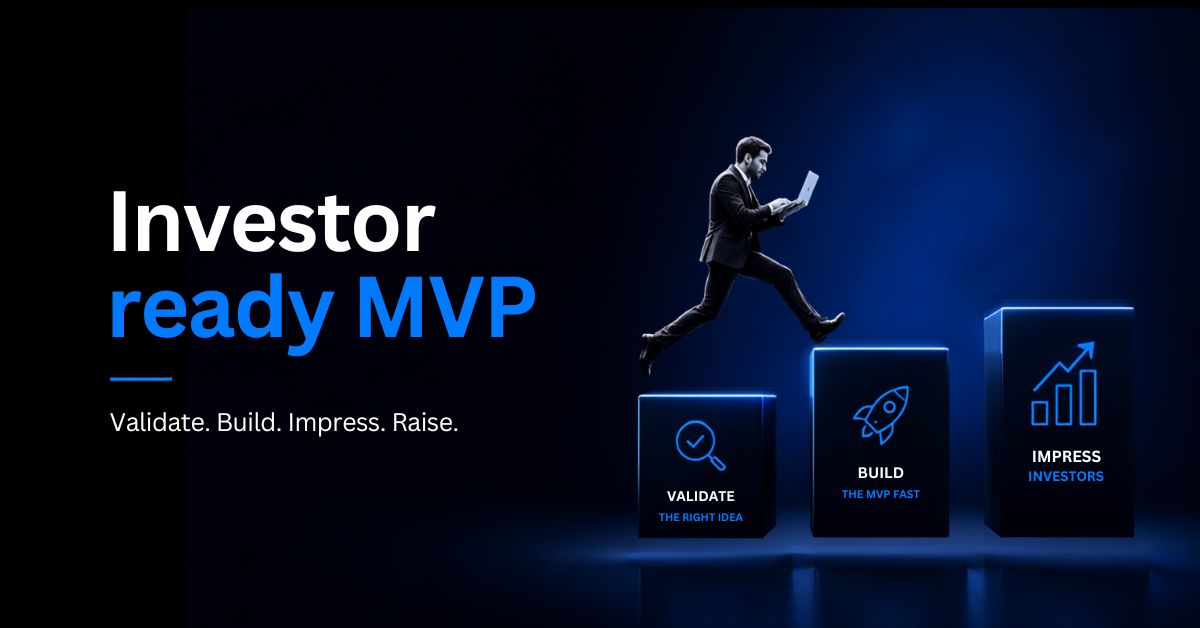
An investor-ready product built through Custom MVP Development is the smallest functional version of your software that proves real market demand while demonstrating a clear path to a scalable business. It goes far beyond a feature-rich application or a simple clickable prototype. Instead, it is a purpose-built, data-driven solution designed to validate your highest-risk assumptions through real users, measurable engagement, and early product-market fit indicators.
Traditional MVP advice often suggests building the minimum set of features and launching quickly. While that approach was effective years ago, the startup landscape has changed significantly. In 2026, investors have evaluated thousands of MVP demonstrations and expect more than polished interfaces or ambitious ideas. They invest in validated traction, customer engagement, and measurable growth.
A successful Custom MVP Development strategy focuses on building only the features required to test your business hypothesis while embedding analytics that capture meaningful user behaviour. This enables founders to present credible evidence rather than assumptions when approaching investors.
This guide explains how to build an investor-ready MVP that stands up to today's funding expectations. You'll discover what features to priorities, which performance metrics matter most, what investors expect to see before committing capital, and the common mistakes that prevent startups from securing investment.
Investor-Ready Is Not the Same as "Just an MVP"
A regular MVP answers one question: can we build it? An investor-ready MVP answers a harder one: is this worth funding? The difference matters, because the data on why startups die points squarely at the second question.
In its analysis of 431 venture-backed companies that shut down since 2023, CB Insights found that 70% ran out of capital and 43% lacked product-market fit, with bad timing (29%) and unsustainable unit economics (19%) close behind. Crucially, the report notes that running out of cash is usually the final cause of death, not the root problem, the disease underneath is almost always weak market demand.
The whole point of an investor-ready MVP is to attack the #1 root cause of startup failure, no market needs before you spend the money that would otherwise run out.
The expectations bar has also risen. According to venture firm CRV, many seed investors in 2026 now expect meaningful recurring revenue or a base of genuinely engaged users before they lead a round though pre-revenue companies aren't automatically disqualified if they show strong validation signals. Their guiding principle is worth taping to your monitor: what matters more than where your traction is right now is where it's going.
What Investors Actually Evaluate Before They Wire Money
Strip away the pitch theater and early-stage investors are really pressure-testing four things. Your MVP exists to produce evidence for each.
• Demand & product-market fit: do real people in a defined market use this, come back, and tell others?
• Engagement & retention: does usage stick, or leak out the bottom of the bucket?
• Unit-economics direction: is there a believable path to acquiring customers profitably?
• Momentum & trajectory: is the line going up-and-to-the-right, consistently, over multiple months?
The 7-Step Framework to Build an Investor-Ready MVP
This is the sequence we use at Techware Lab to take founders from idea to fundable evidence, typically in four to eight weeks. Follow it in order; each step de-risks the next.
Step 1 - Validate the problem before you write a line of code
The cheapest code is the code you never write. Before building, prove the problem is painful, frequent, and something people already try to solve. Run 15–30 customer interviews, put up a landing page with a real call-to-action, collect waitlist signups or pre-orders, or run a "concierge" version where you deliver the outcome manually. If you can't get strangers to lean in before the product exists, more features won't fix it.
Step 2 - Cut scope to a single core loop
The number one killer of MVP timelines is doing too much. Define the one job your product does and the single loop that delivers it — trigger, action, reward — then ruthlessly push everything else to the backlog. A tight core loop ships faster, burns less cash, and produces cleaner evidence because users aren't distracted by half-built features.
Step 3 - Choose a lean, credible tech stack (and own your code)
Match the build approach to the risk you're testing. No-code is fine for validating a workflow; custom code is warranted once the core loop is proven. In 2026, AI-native scaffolding — LLM-powered features, copilots, intelligent automation — can be a genuine wedge, but only when it serves the core loop rather than decorating it. One non-negotiable: own your source code. No-code lock-in and opaque tooling become red flags the moment an investor runs technical due diligence.
Step 4 - Instrument for evidence from day one
An MVP that doesn't measure itself can't raise money. Wire in product analytics and event tracking before launch so you capture activation, funnel conversion, retention cohorts, and engagement automatically. The rule is simple: if you can't measure it, you can't raise on it. The metrics from the table above should fall out of your instrumentation, not be reconstructed the night before a pitch.
Step 5 - Ship an investor-grade experience
Investors extrapolate. A crash during a demo, a broken sign-up, or a clumsy flow reads as execution risk — a signal about how you'll build everything else. You don't need a beautiful product; you need a trustworthy one. Nail reliability, the security basics, and a clean path through the core loop. Polish where the investor and the user actually look.
Step 6 - Launch to a beachhead and gather real traction
Resist the urge to launch to "everyone." Pick a narrow ideal customer profile you can reach and delight, get the MVP into their hands within weeks, and iterate weekly on what the data tells you. For B2B, design partners and letters of intent count as traction; for consumer, it's engaged cohorts and organic word-of-mouth. Momentum with a focused segment beats scattered signups every time.
Step 7 - Package the metrics into a narrative
Traction that isn't communicated doesn't raise money. Turn your evidence into a tight story: the problem and your unique insight, a traction chart that trends up, the direction of your unit economics, a credible roadmap, and a specific ask. Investors fund trajectory and conviction, give them a data room that makes the upward line impossible to miss.
The Investor-Ready MVP Checklist
Before you walk into a raise, you should be able to check every one of these boxes.
☐ The core problem is validated with evidence from real perspective users.
☐ The product does one thing well through a single, clear core loop.
☐ You own the codebase, no lock-in that would fail technical due diligence.
☐ Analytics are instrumented; activation, funnel and retention are tracked automatically.
☐ Your key metrics are trending up across multiple months, not just spiking once.
☐ A retention cohort exists and its curve is flattening for core users.
☐ You have design partners, paying users, or a qualified waitlist — not just signups.
☐ Your ideal customer profile is specific and reachable.
☐ Reliability and security basics are solid enough to survive a live demo.
☐ You can tell a metrics-driven story and back it with a clean data room.
6 Mistakes That Make Investors Walk Away
1. Building too much. Months of "dark" building with no user contact, you arrive with a big product and no evidence.
2. Chasing vanity metrics. Signups and downloads without retention tell investors nothing about value.
3. No instrumentation. If the product isn't measured, you have opinions where you need proof.
4. No focus. An ICP defined as "everyone" produces weak, unconvincing traction.
5. No code ownership. No-code lock-in and undocumented builds become due-diligence red flags.
6. Pitching potential, not proof. "This could be huge" loses to "here's the line going up for four straight months."
Frequently Asked Questions
What's the difference between an MVP and an investor-ready MVP?
A standard MVP proves you can build the product. An investor-ready MVP proves the market wants it and that there's a credible path to a scalable business, it's instrumented to produce the traction and retention evidence investors fund.
Do I need revenue to raise on an MVP in 2026?
Not always, but the bar has risen. Many seed investors now expect meaningful recurring revenue or a base of genuinely engaged users. Pre-revenue is fundable if you can show strong validation and an upward trajectory across multiple months.
How long should it take to build?
With disciplined scope, four to eight weeks is realistic for the core loop plus instrumentation. The timeline stretches when founders try to ship too many features before getting the product in front of users.
Should I use no-code?
No-code is excellent for validating a workflow quickly. Once the core loop is proven or when performance, security, and code ownership matter for due diligence move to custom code you fully own.
Which metrics do investors care about most?
Retention and engagement first (do users come back?), then evidence of monetization and the direction of unit economics such as LTV:CAC and CAC payback. Trajectory over multiple months matters more than any single absolute number.
Conclusion:
An investor-ready MVP isn't a smaller product; it's a sharper one. It exists to turn your biggest unknown into evidence, attack the market-need risk that kills most startups, and hand investors a line that's clearly going up. Validate before you build, ship one core loop, measure everything, and package the proof.
Build your investor-ready MVP with Techware Lab
We design and ship AI-native, production-ready MVPs in 4–8 weeks, with real code you own and analytics built in from day one. 13+ years, 100+ products shipped. Tell us your idea and we'll map the fastest path to fundable evidence.