

Large language models (LLMs) can generate impressive responses, but real-world AI applications often need more than text generation. They may need to plan tasks, use tools, manage context, remember information, delegate work, and follow business-specific instructions.
This is where LangChain Deep Agents becomes valuable. Built on LangChain and LangGraph, Deep Agents provides an opinionated foundation for creating AI agents capable of handling complex, multi-step workflows.
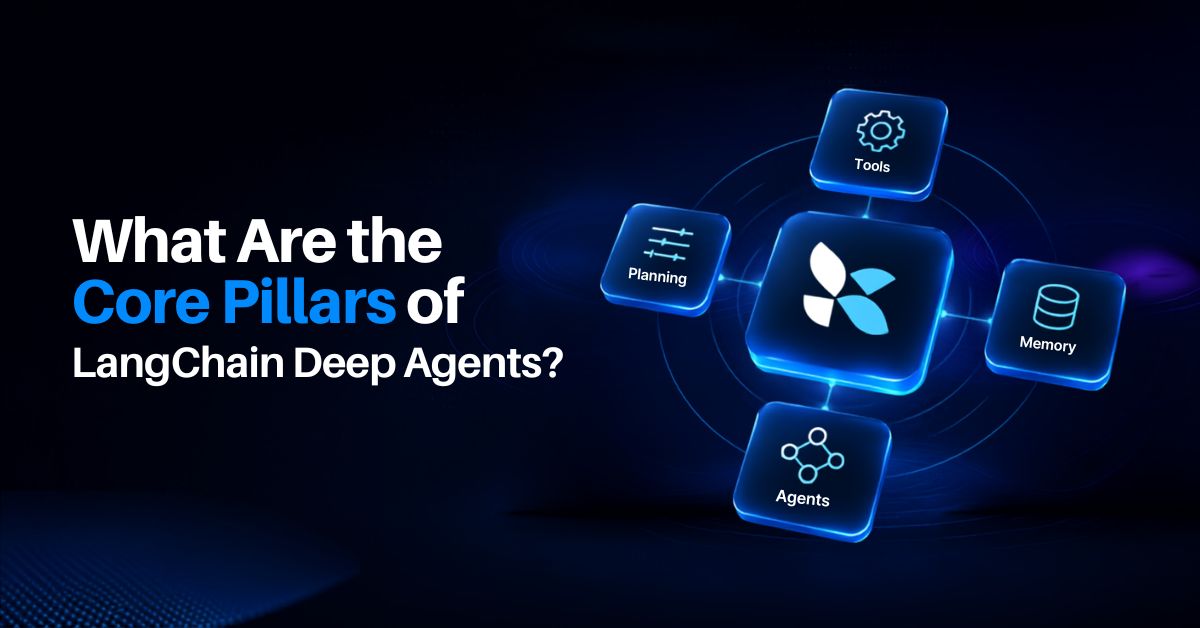
The Core Pillars of LangChain Deep Agents
1. Planning
Planning enables an agent to break a complex objective into smaller, actionable tasks. Instead of trying to solve everything in one model call, the agent can create and track a structured plan.
For example, a research agent can:
Identify relevant sources.
Collect information.
Analyze the findings.
Organize the results.
Generate a final report.
Deep Agents provides built-in todo-based planning capabilities for these workflows.
2. Context and Filesystem Management
Complex tasks can produce large amounts of information. Deep Agents can manage context through filesystem capabilities such as reading, writing, editing, searching, and organizing files.
This is useful for research, document processing, software development, and long-running workflows, where storing intermediate information outside the immediate conversation can improve organization and context management.
3. Tool Usage
Tools connect an AI agent to external systems and real-world actions. Developers can provide custom tools for APIs, databases, analytics platforms, CRMs, search systems, and internal applications.
from deepagents import create_deep_agent

agent = create_deep_agent(
    model="your-model",
    tools=[your_custom_tool],
    system_prompt="You are a helpful business assistant."
)
This transforms an LLM from a simple answer generator into an application capable of performing actions.
4. Sub-Agent Delegation
Deep Agents can delegate specialized tasks to sub-agents. For example, a primary business agent could delegate research, data analysis, or content creation to specialized agents.
This approach helps create more modular and manageable AI workflows.
5. Memory
Memory allows agents to work with information that remains useful beyond a single interaction. Persistent instructions, project information, and organizational knowledge can help agents provide more consistent results across workflows.
6. Skills
Reusable skills allow developers to provide specialized instructions for particular tasks or domains. For example, an SEO skill could define keyword research, content optimization, and internal-linking procedures that an agent can reuse whenever required.
7. Human-in-the-Loop
Not every task should be fully automated. Human approval can be introduced before sensitive actions such as modifying important records, sending communications, or executing business-critical operations.
Building a Basic Deep Agent
A simple implementation starts with create_deep_agent():
from deepagents import create_deep_agent

agent = create_deep_agent(
    model="your-model",
    tools=[],
    system_prompt="You are a helpful AI assistant."
)

result = agent.invoke({
    "messages": [
        {"role": "user", "content": "Create a plan for a market research project."}
    ]
})

print(result)
From this foundation, developers can add custom tools, memory, skills, sub-agents, and human approval workflows.
Conclusion
The core pillars of LangChain Deep Agents- planning, context management, tools, sub-agents, memory, skills, and human oversight- work together to create more capable agentic AI systems. Rather than simply generating responses, these agents can coordinate multiple steps and interact with real-world systems.
For businesses exploring AI agent development, Deep Agents provides a practical foundation for building intelligent, workflow-driven applications that can evolve beyond traditional LLM-based solutions.
Build Smarter AI Agents with Techware Lab
Ready to move beyond traditional LLM applications? Techware Lab helps businesses design and develop intelligent, production-ready AI agents using modern agentic AI technologies. From planning and tool integration to memory, automation, and multi-agent workflows, we can help transform complex business processes into intelligent AI-driven solutions.